The question behind the name
AI is getting smarter fast. That part is settled. The harder question is the one most people skip: who knows how to actually use it?
Not "use" in the sense of typing a prompt. Use in the sense of weaving AI into the texture of real work — into how you research a company before investing, how you read a paper you don't have time to finish, how you probe a problem until the answer stops hiding. That kind of use. The kind where you have a method, not just a tool.
Fewer than one in a thousand people have developed something like this. The rest are circling the runway, watching demos, reading threads, waiting for someone to show them how it actually goes.
That gap is not a knowledge problem. It is a transmission problem. The person with a method has no clean way to pass it on. GitHub lets you share code. Substack lets you share words. Nothing lets you share a living, working, AI-native practice — one that runs, learns from the people who use it, and keeps getting better.
That is what we are trying to fix.
Ship the way you explore. Guide thousands.
Ask + 道: the Tao, not a token
The name carries an old idea.
道 — Dào, the Tao, the Way.
Lao Tzu wrote: 道常无为而无不为 — the Way does nothing, yet leaves nothing undone.
We built a platform on that one line.
AskDAO does not explore for you. That would be the wrong kind of help — the kind that makes you dependent instead of capable. The whole point of AI is not to offload thinking but to deepen it. So the platform's job is not to replace the explorer. It is to make the explorer's way inheritable.
You do the exploring. You develop the method. You upload it once. The platform does the rest — quietly, without being in the way. The method takes root. It reaches people. It learns from the conversations it has with them. It gets sharper. And when the person it helped is ready, they become the next one to guide.
The Way does nothing. Yet nothing is left undone.
(And for anyone wondering: no, not that kind of DAO. No token. No vote. No treasury. 道 is older than all of that.)
From guided to guide
The flywheel has four turns.
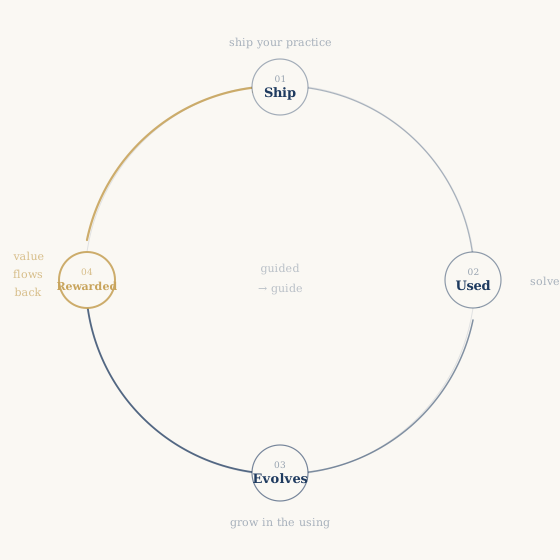
Ship. A builder packages their AI practice — the exact sequence of moves they use to explore, read, probe, and create in their domain — and puts it on the platform.
Used. People use it. Not by reading about it. By actually running it, inside the messaging apps they already live in. The method gets applied to real problems.
Evolves. Every conversation is a signal. What questions keep coming? Where does the practice fall short? The builder sees this, adjusts, and the method sharpens. An AI practice that has been through a thousand real conversations is not the same thing as one that just left someone's hard drive.
Rewarded. When the practice creates value, value flows back. More on this below.
Then the cycle restarts — but now there are people in the community who have been guided long enough that they are ready to guide. They have their own methods now. The flywheel doesn't just spin. It multiplies.
Today you're guided — tomorrow you guide.
This is the only metric that really tells us whether AskDAO is working: not users, not conversations, not revenue — but whether the density of explorers on the platform is growing. Whether people who came to be guided are becoming people who guide.
Why builders, first
A two-sided platform can only cold-start from one side. We chose builders.
The logic is simple: without supply, there is nothing. A marketplace with no sellers is just a waiting room. So the first question we ask is not "how do we get users?" but "how do we earn the trust of the people with something worth sharing?"
Builders who have spent serious time developing an AI practice are not short on options for sharing it. They can tweet. They can write. They can post to GitHub. What they do not have is a place that treats what they built as something alive — something that can keep working and keep improving after they ship it.
That is what we are offering, and that is who we are talking to first.
Upload once. The cloud does the rest.
Here is what happens when a builder ships a practice on AskDAO.
An isolated runtime spins up and runs the practice exactly as designed. It becomes reachable — right inside Telegram, WhatsApp, iMessage, or the web — wherever the builder's community already is. Every conversation is captured. The practice keeps learning from real usage. Community feedback flows back to the builder so they can see what is working and what is not. The builder makes a change. The improvement propagates instantly to everyone using it.
The builder does not manage servers. They do not write onboarding flows. They do not chase feedback manually. They ship the method, and the infrastructure to distribute it, run it, and evolve it — all of that is just there.
This is what "the Way does nothing" looks like in practice. The platform handles the plumbing so the builder can keep doing the only thing that matters: exploring.
Stop giving your best work away for free
The open-source world has a quiet crisis. The people doing the most valuable work — the maintainers, the practitioners, the ones who figured something out and shared it — are burning out. The sharing model that built the internet is not sustainable for the people doing the sharing.
AI practices have the same problem, accelerated. A builder who spends months developing a genuinely useful method has real leverage. But the current options are: give it away for free on GitHub, or don't share it at all.
AskDAO offers a third path.
When people use a practice, the value it creates flows back to the builder — the majority of it. Not a token. Not influence. Actual return. The builder doesn't have to think about monetization or pricing or sales. They just keep building. The platform handles the rest.
This is not about making builders rich. It is about making the work sustainable. A builder who is rewarded for their practice has the breathing room to keep exploring, to keep improving, to keep guiding. The reward is what lets them stay in the game long enough to matter.
One of the oldest ideas in Chinese philosophy: 既以为人己愈有,既以与人己愈多 — the more you give to others, the more you have; the more you share with others, the more you gain. The flywheel is a machine for making this literally true.
Start on your own machine
We are in the early days. There is no case study wall here, no glossy testimonials. The honest position is: we have the infrastructure, we have the flywheel design, and we are looking for the first builders who are willing to test it with us.
The tool that starts everything is open source. You can read it, audit it, and run it on your own machine before you trust it with anything that matters.
macOS / Linux:
curl -fsSL https://askdao.ai/install.sh | shWindows (PowerShell):
irm https://askdao.ai/install.ps1 | iexSource: github.com/askdao/askdao-cli
Open source. Runs locally. One command.
We are not trying to move fast. We are trying to do one thing right: take a builder's practice, make it inheritable, and let it reach the people who need it.
When the ability to explore can be inherited, the speed at which humanity reaches the unknown starts to compound.
That is the only thing this is about.